


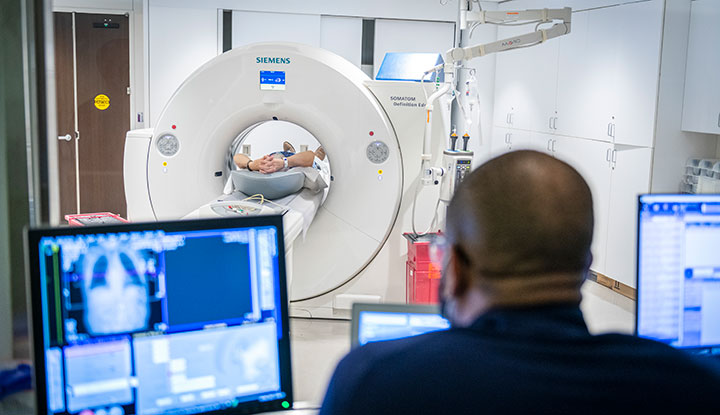
How does a CT scan work?
Healthcare providers use CT scans to see things that regular X-rays can’t show. It produces detailed, clear and precise images of the organs and structures in your body. To get these images, a CT machine takes X-ray pictures as it moves around you.
X-rays alone take flat, 2D images. A CT scan takes several pictures at many angles to create cross-sectional images. Just like you can see the inside layers of a cake when you slice it, a CT can show the “layers” of your body. Taken together, the layers create a 3D image. Some CT scans use a contrast material (dye) to make the pictures even clearer.
Do I need to prepare for a scan?
Your healthcare provider will tell you everything you need to know before a CT scan. Here are some general guidelines:
- Plan to arrive early. Your provider will tell you when to come to your appointment.
- Wear comfortable clothes and remove any metal jewelry or clothing. Your provider may give you a hospital gown to wear.
Your provider might use contrast material to highlight certain areas of your body. Contrast helps make certain tissues, organs or blood vessels easier to see. For a CT scan with contrast, your provider typically injects the contrast (dye) into your vein through an IV. This dye can make you feel flushed or give you a metallic taste in your mouth. IV contrast agents usually flush from your system (when you pee) within 24 hours. Sometimes, you may be asked to drink a contrast liquid. This is especially helpful if you’re having a scan of your intestines.
Here are other things you may need to prepare for a CT scan with contrast:
- Blood test: You might need a blood test to make sure the contrast material is safe to use.
- Allergy medication: If you’re allergic to the contrast agent, you may need to take steroid and antihistamine medications the night before and the morning of your procedure. Be sure to check with your healthcare provider and have them order these medications for you if needed.
What should I expect during my CT scan?
During the test, you’ll usually lie on your back on a table (like a bed). When the scan begins:
- The bed moves into the doughnut-shaped machine. At this point, you’ll need to stay as still as possible because movement can blur the images.
- You may also be asked to hold your breath for a short period of time, usually fewer than 15 to 20 seconds.
- The scanner takes pictures of the area your healthcare provider needs to see. A CT scanner is relatively quiet.
- When the exam is over, the table moves back out of the scanner.
- A technologist trained specifically to perform CT scans will be there to guide you through the entire process.
How long does a CT scan take?
CT scans usually take about an hour. Most of that time is for the preparation. The scan itself usually takes fewer than five minutes.
Are there risks or side effects?
Healthcare providers consider CT scans safe. CT scans for children are safe, too. Like X-rays, CT scans use a small amount of ionizing radiation to capture images. The level of radiation you’re exposed to is small. If you have concerns about the health risks of CT scans, talk to your healthcare provider. They’ll help you make an informed decision about the scan.
CT scans themselves usually don’t cause side effects. But some people have side effects from the contrast material. These side effects may include:
link